Tassos Tataroglou was born in 1985 in Thessaloniki, Greece, and has lived in Basel since 2013. His musical formation took shape across many years of study — from music theory, trumpet, singing and pedagogy at the conservatories and universities of Thessaloniki, to a Master’s in specialised musical performance with a focus on free improvisation at the Music Academy of Basel, where he later also followed a further education programme in Music and Research. The impulse to keep learning has remained a constant: his study of the shakuhachi — rooted in the Myoan lineage and the temple repertoire of Myoanji, developed through intensive study and seminar participation across related traditions — reaches into the philosophical and aesthetic foundations of Japanese artistic practice and their resonance with contemporary music. In June 2024 he received the name Genpō 玄峰 from Seian Genshin, 42nd Kanshu of Myoan-ji temple. Alongside this, his engagement with the music of his own cultural roots — the Balkan tradition, with its bagpipes and regional flutes — remains a living thread of study and inspiration.
At the heart of his instrumental practice is a continuous process of invention and expansion. The Microtone-Duplex trumpet — designed in 2016–2017 by combining construction principles from Renaissance brass making through to the 20th century — has become both a primary creative tool and a research object, significantly extending the tonal and timbral possibilities of the instrument. Working with electronics that range from pedal effects and feedback loops to modular synthesizers and sampling, he has developed a performance approach in which instrument and electronic environment become inseparable: in one dimension of this practice, the bell of the trumpet — once a projector of sound — is turned inward and becomes an ear, receiving rather than transmitting, while the valves take on the role of a controller in an analogue synthesizer. In parallel, and in a quite different direction, his transcription of Tsuru no Sugomori — a honkyoku from the Renpoken Temple repertoire — for the Microtone-Duplex trumpet opened a second line of inquiry: exploring the instrument as a potential vehicle for the interpretation of traditional music. Published both as a CD single and as a book presenting the score in western staff notation, this case study also became the thread that led him to begin studying the shakuhachi itself. In June 2023 the work was performed at the opening concert of the International Shakuhachi Festival of Prague.
He is a member of the Insub Meta Orchestra (Geneva) — with whom he has recorded several albums and performed at major festivals across Europe and Russia — and of Ensemble Ortolan (Basel), a collective for experimental sound practices in which he is active both as a performer and as a composer. His project Leuchtfeuer, realized with the Trio Nicolai/Ruffing/Tataroglou, stems from a deceptively simple idea: the signals of lighthouse beacons — the coded language of maritime navigation — become the structural backbone of an electroacoustic, improvised music. The project has been presented extensively in Switzerland and across Europe — including a tour through Italy, Serbia, North Macedonia and Greece in 2024 — and has to date involved over twenty guest musicians in its ad-hoc collaborative format. A related research project, Empty bells, cables and knobs, approaches the Fuke-Myoan shakuhachi honkyoku repertoire as a source for graphic notation systems and improvisational structures developed through the Microtone-Duplex trumpet and electronics — a line of work deepened by a Pro Helvetia-supported research stay in Japan in 2025, involving fieldwork, participation in Myoan Kyokai events, and exchange with musicians and scholars.
His work has grown through sustained exchange with artists from other disciplines — dancers, visual artists, filmmakers and writers. These encounters leave direct traces in how he composes and improvises: in the formal logic of a piece, in its texture, in the questions it sets out to explore. Small Betrayals, developed from a close reading of Balzac’s novella A Passion in the Desert, and Materia Ignota, created in collaboration with visual artist Lisa Amble for Galerie Eulenspiegel Basel, are two instances of this cross-disciplinary thinking made audible. His personal discography also includes Escape, a solo work for trumpet and electronics; 2:1, an ad-hoc improvisation with double bassist Georg Kokkinaris; and Nychterino, among others.
In 2016 Tassos co-founded El GreChor — a choir whose name playfully combines El Greco, the famous 16th-century painter, with Chor, the German word for choir. Rooted in the urban musical idioms of Greece, its repertoire brings together works by Greek composers of the 20th century with contemporary choral arrangements of traditional songs. In 2023 he extended this interest into the countryside with Balkan BBQ: a band dedicated to the folk traditions of Greece, the Balkans and Asia Minor, where centuries of shared history have produced both a strikingly common musical language and a wealth of vivid local differences. He also conducts Chor Ammerswil, its repertoire ranging across rock, pop and Swiss dialect songs.
Tassos has composed music for theatre and film, and has been a guest lecturer at the University of Basel and the Volkshochschule beider Basel. He teaches music in secondary education.
Tassos understands music as a space of encounter — between people, cultures and sound worlds. In his projects, whether with professional musicians or amateurs, he is drawn to the question of what musical cultures hold in common, and how their differences can deepen rather than divide. Equally central to this is the act of listening: not merely as a prerequisite for playing, but as a practice in its own right — a form of attention that shapes how we understand others and ourselves. This curiosity carries an almost ethnographic dimension: music as a living testimony of human experience, a language that does not dissolve cultural boundaries but brings them into focus — and in doing so, makes them possible to cross.
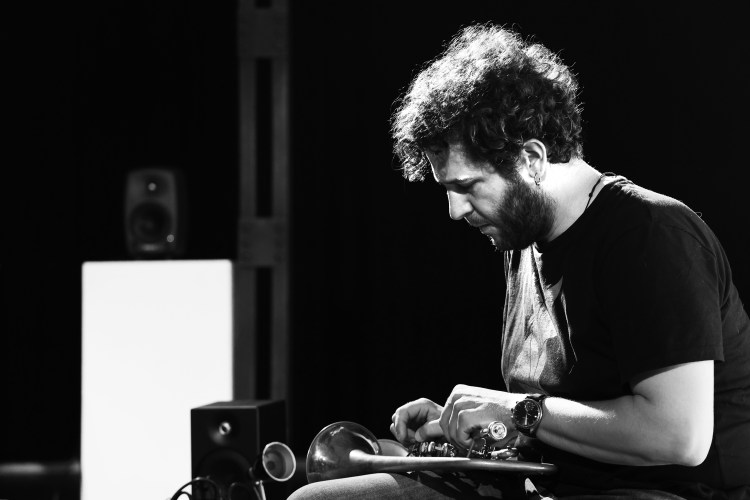
FIM Basel, Photo by Urs Schmid

